✨Discover the Fascinating History of Sheer Hosiery with Me 🌸

I’ve always loved the kind of history that reveals how real people lived — the fabrics they touched, the choices they made, the quiet little luxuries they treasured. When I first learned how difficult it was to find stockings in Britain during the war, it made me wonder: what did people do before nylon came along and transformed everything with its silky promise?
That small question opened up a far more enchanting journey than I expected. The history of hosiery isn’t just a timeline of stockings and tights; it’s a story of invention, scarcity, craftsmanship, shifting expectations, and moments of self‑expression that stretch across centuries. And one of the most charming discoveries? For most of history, men wore hosiery just as confidently — and sometimes just as beautifully — as women did.
I’ve written this page with the same soft, welcoming tone as the rest of my blog: easy to follow, open to everyone, and gently feminine without excluding anyone. By following the story chronologically, you can watch hosiery evolve from early woven leg coverings to the silky, glossy sheers many of us adore today.
I hope this journey leaves you feeling informed, inspired, and a little more connected to the legwear you love — because its history truly belongs to all of us, and there’s something quietly magical about knowing the story behind the softness we slip into.
🌸Firstly, a Definition of What Hosiery Is 🌸
Hosiery refers to garments worn directly on the feet and legs — everything from socks to stockings to tights 🌷.These pieces have always been worn by both women and men, and the word itself comes from the work of a hosier, someone who made or sold these items.
In textile terms, hosiery describes fabrics created through looping or knitted structures, which is why the name traces back to hose, one of the earliest knitted garments in European clothing history 🧵✨.
Although tights and stockings are often the first things people think of today, they’re just one part of a wonderfully varied industry. Men’s socks, women’s sheers, children’s tights, performance hosiery — they all sit under the same soft, stretchy umbrella 🩰💗
✨ Modern Summary ✨
Hosiery is a category of clothing that includes any garment worn directly on the feet and legs — such as socks, stockings, tights, and pantyhose. These items are usually made from fibres like nylon, cotton, wool, or blends, and they come in countless styles, finishes, and thicknesses to suit comfort, practicality, and fashion 🌸Why This Matters Before We Dive Into History 💕
Understanding what counts as hosiery helps set the stage for the journey ahead. Hosiery has evolved through centuries of craftsmanship, scarcity, invention, and shifting social norms — and knowing the basics makes the story clearer, richer, and far more enjoyable ✨.It also reminds us that hosiery has never belonged to just one gender, one purpose, or one moment in time. Its history is shared, surprising, and beautifully universal — just like the spirit of your blog 🌷.
🌿Let's Transition Into the Past 🌿
The Evolution of Hosiery: From Survival to Silk Stockings 🌸✨
The story of hosiery begins not with fashion, but with the simple need to survive. In pre‑history, early humans wrapped animal skins around their feet and legs to protect themselves from the cold and harsh terrain 🌬️❄️. These early coverings were crude, practical, and essential — the very first steps toward what would one day become stockings and tights.
Ancient Traditions 🏺
As ancient civilizations blossomed, so did more thoughtful ways of protecting the legs. The Greek poet Hesiod (8th century BC) mentions piloi — soft liners made from matted animal hair or felt 🐑✨.By the height of the Roman Empire, practicality met discipline. Roman soldiers and citizens wrapped their legs in fasciae — long strips of leather or woven cloth — providing warmth, support, and structure during long marches and daily life 🛡️👣.
The Era of “Cut‑and‑Sewn” Hose 🧵
With the rise of weaving, hosiery entered a new chapter. But woven cloth has no natural stretch, so early hose — often called “cut‑ups” — were shaped by cutting fabric on the bias and stitching it together. They were clever, but far from perfect 🌬️.These early hose were usually made as two separate legs, worn by both men and women. They sagged easily and needed cords or garters to stay in place — a charmingly imperfect ancestor of the sleek hosiery we know today 🌸🩰.
The Breakthrough of Knitting ✨
Everything changed when knitting arrived in Europe around the 14th century. This looping technique created fabric with natural elasticity, allowing hose to finally mould to the shape of the leg — a quiet revolution in comfort and fit 💗.Most historians agree that knitting likely entered Europe via the Middle East, carried along trade routes and cultural exchanges 🌍. This global influence adds a beautiful depth to hosiery’s story — a reminder that fashion and craft have always travelled across borders.
Renaissance Sophistication 👑💫
By the Renaissance, hosiery had transformed from necessity to luxury. Silk became the fabric of choice for the elite, offering a glossy, elegant finish that hugged the leg like a second skin ✨.Knitted silk stockings became so desirable that Queen Elizabeth I famously refused to return to woven hose after trying her first knitted pair in 1560 — a royal endorsement that helped shape fashion for generations 🌹👑.

The era culminated in 1589 with William Lee’s invention of the Stocking Frame. This first mechanical knitting machine bridged the gap between artisanal craft and the industrial future, allowing for a level of precision and intricacy that defined the sophisticated stockings of the modern age.
The History of the Stocking Frame
Modern hosiery began with the development of the stocking frame, the first major innovation in the craft since the invention of hand knitting. It holds a significant place in history as the first mechanical machine used in the textile industry.

The Worshipful Company of Framework Knitter.
Was one of the Livery Companies in the City of London incorporated by Oliver Cromwell, Lord Protector of the Commonwealth, on 13th June 1657, reissued as a Royal Charter in 1663. There are about 108 of these guild or Livery Companies covering many trades some of their original can be traced back to medieval periods, there purpose was to bring together people from the same trade to help and protect them and maintain standards within the industry. The Worshipful Company of Framework Knitters is still active today with its own web site. www.frameworkknitters.co.uk/
The next addition to the knitting frame was carried out in
1758 by
Jedediah Strutt who introduced an attachment for the frame called the
3
"Derby rig which would allows the frame to also knit cotton making even
finer stockings.
Most frames were used by individuals and family concerns as a cottage industry, around 1812 it is estimated that there was over 25,000 frames in use, most frames were not always own by the frame workers a lot frames would be leased.
The Frame knitting industry originally started in London
alongside the
Protestant Huguenots silk weavers who had come over from France to
avoid
persecution from the Catholic in the 16th and 17th Centuries setting up
in Spitalfields London, which soon became known as
'weaver town'.
The frame worker and the hosiery industry were now moving always from
London
and becoming based in the West Midlands.
By the end of the nineteenth century most of these frame working would slowly die out because they were uneconomic to operate as the larger mill took over and could use the principle of mass production to produce even cheaper cotton isle and wool stocking. Just a very small number of workers would remain in independent use until the end of the century.

Silk hosiery manufacture was slightly different and would also remain in smaller manufactures for some time to come.

Until recently hosiery was worn equally by men.
If you look backwards into fashion history you see that men also wore long cotton or silk stocking which finished above their knee britches, as shown in this drawing of Richard Sackville 1589 -1624 with his stocking tied with a ribbon to hold them in place.


Lady Rose's servants and the majority of ladies around this time would still have to wear wool stocking of every day and maybe if they were very lucky they would have a pair of cotton isle stockings just for the Sunday best, as with all nice lades at this time had long floor length dresses you would not be able to see their feet and stockings of course wear today
Victoria ladies and there stockings.
Victorian stocking although unseen were not always as plain as you would think they are.

Stockings were made in both cotton and silk and as the advert says available in all desirable colours yellow, lavender, gold and even sky blue, some were made in drop stitch and others ribbed cotton lisle embroidered on the leg.
Why an alternative to real silk would be desirable.
Real silk has always been very expensive partly because the main producers were in the far east and North America and the silk had to be transported over long distances, by the end of the Nineteen century several other factors started to effect the cost of silks and pushing the price up even further.
a) The silkworm disease in Europe (1855 -1870).
b) The Taiping Rebellion in China (1850-1864).
So there was great interest in finding a cheaper alternative to natural silk and of course for anyone who was successful in developing one would clearly be a handsome profit to be made.
Viscose - Is the new wonder fibre.

Viscose was discovered by Joseph Wilson Swan in 1850
English chemist who was working on developing the electric light bulb.
Swan needed a fine fibre
for the
filament of his new electric light bulb; he first came up with a fibre
made
from cellulose nitrate which is derived from the naturally occurring
cellulose
made from extracted wood pulp.
Hannah Swan became interested in this fibre and started using it for her crochet work, Hannah called this fabric 'artificial silk'.
Unfortunately cellulose nitrate was not found to be a practical solution especially for Joseph and his electric bulb because viscose was slightly explosive after more work in a slightly different direction he found that a carbonized bamboo filament had significantly better results for him.
 |
Work did continued on this new artificial silk fibre by other scientist Count Hilaire de Chardonnet (a French chemist) achieving the first full scale production of Viscose in 1889, his fabrics of artificial silk caused a sensation at the Paris Exhibition.
Two years later he built the first commercial rayon
plant at
Besancon,
France, however his cloth was also slightly inflammable and sales of it
started to
declined when the public realized this flammability.
Until three British inventors, Charles Fredrick Cross,Bevan and Beadle, patented a way
of
making a safe and money flammable artificial silk in 1892.
Apart from fabric Cross, Bevan and Beadle, tried to make solid objects out of viscose like umbrella handles with which turned out to be too brittle, further development made it possible to spin the fibre into thread for embroidery and trimmings probably this work was carried out by Courtaulds textile company. The term "spin" is often used in the context of Viscose , this is not the same technique as the in the textile mill with cotton or wool.
 The British patents for artificial silk were taken over
by
Courtaulds in
1904 for approximately ?25,000, they produced the first commercial
fibre in
1905 in a factory on the outskirts of Coventry (UK).
The British patents for artificial silk were taken over
by
Courtaulds in
1904 for approximately ?25,000, they produced the first commercial
fibre in
1905 in a factory on the outskirts of Coventry (UK).
 A
new
century and a change in women fashions.
A
new
century and a change in women fashions.
With the sad death of Queen Victoria in 1901 fashions would now starting changing the Victorian hour glass silhouette was going out of fashion been replaced with the "S-bend" or "S-curve" silhouette which in reality would not as survivor as in this advertising illustration for corsets suggests. 
The ladies of Britain now had to play catch-up to the continental ladies with their fashions and the new exciting styles coming out of Paris and other European capitals.
Fashion had now taken on a whole new look based on Orientalism with its soft drapery, and bold prints. The lines of Russian peasant costume appeared in hip length tunics, a style that lasted throughout the next few years. The hem line at the start of the twentieth century was still at the floor and would remain there for around the next 10 years. There really was not any reason for this to change at this time the fashion designers were concentrating more on the silhouette, textures and patterns of the fabrics than the hem line and stockings were still unseen.Artificial silk
goes into
full production.
The first artificial silk stocking is reported to have been made in 1910 although it seems more likely that full production did not start until a year or so latter. There were three different method of producing artificial silk the American Viscose Corporation at this time used the cheapest method at their production plant.
Sheer stocking are now a lot more affordable
For the next few years there is little information available about ladies hosiery of this period and not many example's Designer's and couturiers first raised hemlines several inches above the floor in 1915 when they created the war time crinoline" this was still a full skirt just slightly shortened .
Many women greeted this new look with pleasure and saw it as more practical solution which better suited to a time especially as a lot of women were now having to entering the workforce at unprecedented levels to replace the men who were now volunteering to join the armed forces and go to the front in France and Belgium.

The higher hemlines exposed a gap between the tip of the
boot
and a skirt
them. The look distracted from the overall appearance of an outfit, so
the high
button boots of the past were abandoned. Not only did women's hemlines
rise to
mid-calf length, but more exciting yet, ladies wore these shorter
styles with
sexy heeled shoes with that featured a slight curve and flesh toned
silk
stockings,
Not that high button boots and corsets were not totally abandoned
instead these
style give ladies greater flexibility for comfort.
The new Spirella corset offered a greater range of movement than the old fashioned type and purported to improve posture to benefit overall health.

By 1915 ladies were starting to wear sleeveless dresses and as this advert on the right says that fashion say that underarms must be as smooth as the face.
With the hem line now going up it and the legs now showing it would not be long before pressure from advertisements would also lead to ladies shaving their legs and thus allowing them to start wearing increasingly sheerer stockings.

After the armistice, November 11, 1918, there was great relief that the war was over recovery by society was difficult as there was also a underlining sadness for all the people who were lost, and now dearly missed , combined with the devastating effects of the 1918 flu pandemic which almost brought the world to its knees people just felt crushed and cynical as they moved into the peace time a new feeling of freedom mixed with disillusionment combined to create a new kind of culture - a live for today, devil-may-care society that led into the roaring 20's and the distinctive look, sound, and fashion of the jazz age.
Dupont start to make silk (artificial
silk). 
Dupont (a large us chemical company) became very interested in artificial silk as they had initially missed out on this product ten years before, there first attempted to enter this market was to buy out the American Viscose Company, the AVC offered Dupont 60% of their company for $30 million, Dupoint thought this was too much as American Viscose Company total assists were only values at $10 million.
Dupont finally entered into an agreement with a French company Comptoir Des Textiles Artificiels who was the largest European manufacturer of Rayon at the time with plants in France Italy, Belgium and Switzerland who transferred there owner patents to make artificial silk by the Count Hilaire de Chardonnet method over to Dupoint in return for $4 million.
Dupoint then sets up a USA company which is called Dupont Fibre silk company.
Ladies now decided they had to shave their legs.

Ladies started shaving they legs mainly for
aesthetic reason when the hem line started rising around the time of
WW1, initially they would have use men's razors then razors especially
designed for ladies came onto the market. The first adverts for ladies
razors
appeared in around 1922 or 1924 (other
dates do crop up for this even
like 1925 and 1926).

This is an early advert for a ladies razor
A 1920's ladies safety razor.
Artificial silk has its name changed to Rayon.

Manufactures thought that the word "artificial was not very appealing name , a committee from the United states department of commerce and various commercial associations was set up to decide upon a new name they first hold a competition with a very large prize for the time of $1,000 for the best name of the 10,000 entries no one name was thought to be right.
Another fashion trend started by the flappers was to decorate their stocking by painting small motives on the leg, some would go as far as having their boyfriends face pointed on both knee like this lady on the right has had done.

So the committee decided to choose their own word, rayon taken from the French for "rays of light" so from 1924 "artificial silk" was known as rayon ,like all names there is sometime a sleigh turn certainty about why they decided upon a name it could also be rayon(sun = ray, on = cotton) accounting for 70% of the sales of stocking. Dupont fibre silk company decided to rename the company to the Dupont rayon company in 1925.
Hosiery really came to the forefront in the Twenties
Although we think of the roaring 20's was all about flappers (the young fashionable ladies) wearing short dresses and showing off their stocking tops or rolling down there stockings that was only a small part of the story

Many other designs were also popular like clock painted on the side of the stockings.
As this American advert for rayon stocking shows, there are several very interesting points
These are another style of painted stocking an art form which was very populate in the 20's I would say it was done mainly on silk stocking.

The Edwardian style of corsets were still worn by the older generations in the early part of the 20's the stockings been clipped to the bottom these would as the decade progressed evolve into a girdle like garment for the younger ladies they would still wear the girdle in daytime but occasionally especially for evening wear these would discarded rolling down there stockings wearing a garter, first a roll on garter or sometime a very decorative one.
Another example of painted or decorated stocking form the 1920's
This practice of painting stocking would re-emerge again in future decades although today they are not hand painted instead printed,
 |
Whist the most common way that a 20's ladies would hold up there stocking by attaching then to the bottom of the girdle
Another solution was these of a garter the one shown in this photo is more decorative than functional they often had decorative stones in layer and like this one matched the gold kid shoes these decorative garter was more for decoration than practical use.
Roll on garter often worn to cover up the roll on garter which was functional but in a way boring to see decorative garter are still made and worn today they do not serve any practical purpose they are worn mainly by brides at their wedding for tradition and romantic reasons.
Patterned
stockings were
also very fashionable in the 20's.

What was shocking back then was the amount of leg on show.
These are a pair of seamed silk
stocking dating from around
the 1920's made by I.R Morley they have cotton soles and welt with a
seam up
the back.
I would say they are thee equivalent thickness of today's 60 denier
hosiery.
they were no way as long as modern stocking or today with the welt
coming just
above the knee as skirt lengths back in the 20's were below the knee in
many
instances and as silk was still relatively expensive there was not the
need to
have the extra expense in knitting a legs that was longer than it
needed to be.

By the 1930's an average lady would
now own three pairs of
sheer stocking compared this to the start of the century when a lady
would have
just one pair this was because the price had dropped so dramatically by
the
30's for hosiery.
Most likely these would be a combination of silk, rayon and cotton
whilst no
new fibres were developed in this decade for hosiery what you will find
that is
there was an improvement in the manufacture of hosiery combined this
with the
falling price in silk more finer and more elegant stocking were
produced.
These are a pair of very early 1930 silk stocking or even late 20's,
the
natural or tan shade which was seen as risky in the twenties had become
acceptable by the 1930's, these are still opaque in thickness and still
relatively
short in length, they have a reinforced heel and foot.
Another pair of silk stocking slightly later in date than the ones
above the
main difference with these is that they are a lot sheerer than the
previous
ones, still not as sheer and "nylons" they would have been at the top
of the price range and keep for special occasions. "often know as fine
gauge"


These are the earliest rayon stocking I presently own originating from the 1930's seamed rayon stockings one in black the other in a flesh or blush tone.
They can be described as silky smooth, to the untrained eye they look like silk hence the name artificial silk which was a namely mainly used in the 20's not commonly used today, they are semi sheer and typical of rayon have a shine to them. They are fully fashioned with a reinforced foot toe and heel and along with a Cuban heel.

The new "All in ones"
Up until the 1930's in general terms a set of ladies foundation wear would consist of three items, a bra, corset and knickers with a slip or chemise over the top ,in the1930's this would start to change with the introduction "All In One".
This was sometimes called the "corselets" which in theory combined these three together most ladies would still prefer to also wear a pair of knickers over the top of this garment. The stockings were attached with small clips made of metal at the end of a length of elastic often adjustable at the bottom of the all in one girdle going to the stocking welt.
The actual suspender part of these all in one were shorter the in the 1920's so the stocking were now a little longer in length so that they could reach these clips.
The Invention of Nylon.

Like many great invention, nylon was a by-product of the work started back in 1926 in the Du Point laboratories.
Dr. Wallace Hume Caruthers joined the Du Point laboratories in 1928 as head of organic chemistry research at the Wilmington laboratory Delaware.
Wallace Carothers was born on April 27 1896 started his career at Capital City Commercial College in Des Moines, Lowa, in a program of accountancy and secretarial administration, whist teaching accountancy at the Tarkio College in Missouri he studied science, as an undergraduate student was appointed head of chemistry, Although a talented chemist the real reason for his appointment was the shortage of suitable people due to World War 1.He received his PhD from the University of Illinois and then became a professor at Harvard where he first started his research into chemical structures of polymers in1924.y 1928 the DuPont chemical company opened an Organic Chemicals research laboratory for the development of artificial materials, deciding that basic research was the way to go - not a common path for a company to follow at the time, it's reported that DuPont were investing $20,000 per month into this laboratory.
DuPont’s Charles Stine (Stine known for his work on developing TNT established the Organic Chemicals Division within the DuPont Chemical Department in 1916 by 1930 Charles Stine was made a vice president and director of DuPont in 1930) he recruited Dr. Carothers for the fundamental research program that Stine was then organizing. Elmer K. Bolton, Carothers immediate boss, asked him to investigate the chemistry of an acetylene polymer that might lead to a synthetic rubber..
April 1930, Carothers team discovered neoprene synthetic rubber and synthesized the first polyester super polymer, the forerunner of nylon.
April 1930 and a lab assistant working with esters compounds which yield an acid and an alcohol or phenol in reaction with water discovered a very strong polymer that could be drawn into a fibre. This polyester fibre had a low melting point, however. Carothers changed course and began working with amides, which were derived from ammonia.
1935 Carothers found a strong polyamide fibre that stood up well to both heat and solvents. He evaluated more than 100 different polyamide before choosing one for development.
Dr. Carothers married Helen Sweetman in 1936, a colleague of his at DuPont. A year later, April 29th 1937 he tragically committed suicide alone in a hotel in Philadelphia after a lifelong bout with depression.
Nylon changed the way people dressed worldwide and rendered the term "silk stocking" once an epithet directed at the wealthy elite obsolete.
The very first nylon stocking.
Nylon stocking were brought to market remarkably quickly, in part due to Dupont's learning from there experience with rayon and missing out on that market.

After determining that low-cost production were possible and settling on a target market (women's hosiery), Dupont produced a preliminary batch of nylon staple to confirm that the nylon hose would be practical, the sample was delivered to a commercial knitting mill under conditions of extreme secrecy (the research chemist who delivered the samples to the mill even slept with the sample on the train).
It took two test runs and a little further
development to convince Dupont to build a pilot plant in Wilmington,
then finally a full-scale production facility in Seaford Delaware on
the 30 th of March 1939 Dupont made an agreement with ICI (Imperial
Chemical Company) for the exclusive rights to produce nylon in the UK,
in conjunction with ICI rivals Courtaulds, together they set up a
third company called British Nylon
Spinners Ltd (BNS).
The very first pair of nylon stocking
when on sale as a small trial in a department store in
Wilmington, Delaware (U.S.A) made by Du Point on the 27 October 1939
just to test the market.
They were a huge success with ladies
coming from miles around to buy the new nylon stockings, the store sold
out in a few hours as news spread about the area about these
stockings. On the 3rd of September 1939 Britain and France declared war
on Germany
following the German invasion of Poland a month before Du point
launched their
nylon stockings.
January 1940 ICI transferred its exclusive rights for a fee
over to British
Nylon Spinners (BNS) to manufacture and distribution of nylon yarn in
the UK,
because British was at war the priority of the production of nylon was
given
over to war production of rope and parachutes along with other war
related
product instead of yarn for the production of stockings.
By the 15th of May 1940 the USA the first nylons stocking
when
on sale to
the general public for the first time selling over 72,000 pairs in the
first
day alone.
The total sales for the first year are estimated to have
been
around 64 million
pairs With these new nylon stocking du point captured 30% of hosiery
market,
although there wear plenty of nylons available for the ladies in
the
United States very few pairs would find their way across the Atlantic
Ocean and
onto the legs of the UK ladies. This was because of the
success the
Germans were having in cutting Britain off from America with
their
"U" boats fleet sinking an average of 22,000 tons of ships each month
from the merchant fleet. Only essential supplies to keep the British
war effort
going was brought across this dangerous route nylon stocking were not
one of
the essential
s needed in the UK.


This fun photo which might have been staged by the photographer shows a lady who look so pleased to be able to buy a pair of stocking has decided to put them on whist sat in pubic on the side walk.
The British Nylon Spinners had their first production plant in operation in Coventry by 23 January 1940, it's total output of nylon gong to fill government contracts for war materials, a second plant Stow Market was also confined to government production mainly nylon for parachute fabric.
With very few pairs of nylon stocking to wear ladies had to "make do and mend" a term which would become all too familiar as the war progressed in the UK.
 By
1941 clothing rationing come in to effect in the UK, The government
controlled the styles of clothes and how they were made to reduce the
quantity
of raw materials require to make them this was called the CC41
(
Controlled Commodities)
standard,
the number of individual items a person could buy was restricted by
issuing
clothing coupons.
By
1941 clothing rationing come in to effect in the UK, The government
controlled the styles of clothes and how they were made to reduce the
quantity
of raw materials require to make them this was called the CC41
(
Controlled Commodities)
standard,
the number of individual items a person could buy was restricted by
issuing
clothing coupons.
A notice which was published in Newspapers showing the number of clothing coupons a person needed to buy a item.

Stockings were rationed like all clothing (except second-hand clothes) a lady required 2 clothing coupons to buy 1 pair of stocking out of her total allocation of 66 coupons per year (1941) by the end of rationing the allocation had fallen down to 36 per year cotton, silk and wool stocking all came under the CC41 regulations.
The number of clothing coupons which were needed to buy an item was published by the board of trade in newspapers like the one on the left.
The US government followed with their rationing on the 7th December1941 forming the war production board (WPB), this was to regulate the production and allocation of materials.
Nylon now came under the control of this board the amount of fibre used in civilian clothing was now restricted so by that 1943 it was nearly impossible to buy a pair of the new nylons in a store in the USA.
Du point ceased production of nylon stockings and switched over to making parachutes, airplane cords and ropes, it's Seaford plant made parachutes and b-29 bomber tires with mainly a female work force as many men when into the armed force.

It also has to be mentioned that at this time Germany had also developed a man-made fibre in top secret called Perlon a synthetic fibre similar to the American nylon - this was invented by the German chemist Dr. Paul Schlack at I.G.-Farben. They also had a test run to make Perlon into ladies stocking after which it was declared to be a military defense material under the code name "Perluran" be one again production was diverted mainly into the German war preparation and later the war itself.
Join the forces and you would have some stocking issued.
For the ladies joining one of the armed forces then things
were lightly
different as you would be issued with a uniform which would include
3pairs of
cotton lisle stockings and two suspender belts/corset, it's probable
with time
that the female service personnel would sneak in their own hosiery and
undergarments but this was against regulations.
There are stories of the female work force at the top secrete Bletchley
park
drying their underwear next to the hot computers, which was of course
was very
much looked down upon.
USA enters the war and there are now a few more pair's nylons around.
With the build up a American troops
in preparation for the
invasion of Europe a small number of nylon stocking were brought into
the UK by
these GI's.
Compared to the potential demand this was still a very small number,
mainly
they would be given out to their girlfriends.
At this time they might have been a small number of nylons made during
the war
years these would be mainly for proper gander purposes it very
difficult to be
certain about this.

The lengths which women would go to wear a pair of stockings.
These are a very rare pair of nylon stocking as you can see they are new and unworn made in the UK by, they have the CC41 mark in the top right of each stocking, close examination shows these stocking are not as sheer as you imagine.
Now with a shortage of stocking ladies would re-sort to wearing the hosiery they already had store away for special occasion pre-wartime, these m would have been silk stockings, cotton lisle or rayon.
Life without stockings.

The majority of ladies would not have nylons to wear, an estimation was that only 1% of ladies wore nylons regularly. all the others had to become very resourcefully because it was thought that a lady without stockings was improperly dressed if she was out in public.
Ladies started to draw a line down the back of their leg to achieve the look of wearing stocking using an eye brow pencil or something similar to give this seamed effect.
For drawing a seam on your e.g. Max factor brought out a devise which helped to guide her to create a straight seam down the back of her leg ( left photo) instead of doing y or have someone ( left photo ) do it for you.
Occasionally ladies would even try to colour their legs with gravy browning mixed with a cream other home-made formula were developed using other house hold products to produce the desired effect, the problem I am told is if it rained when she was wearing some of these it would end up be a streaky mess down her leg.

A multitude of commercial products were also marketed towards the end of the war for colouring your legs to look like they were wearing stockings max factor brought out a cream around this time to simulate stockings which was applied in a similar way to normal face foundation today.
Path'e news made a news real showing this cream been applied by a lady to her legs, cosmetic were also rationed in war time so the max factor cream might also have been hard to come by another way to simulate a seam of a stocking was have a line tattooed on the back of their legs, this was more often done by wife of seamen, who were used to seeing tattoos on their husbands as a long tradition with seamen. Today a few ladies still decide to have a tattoo seam done.
For the ladies who did have a pair of nylons to wear the
worst
thing that could
happen was when she got a ladder or run in them as nylons were so
precious products were marketed to help her minimize the damage by
sealing the thread.
Ladstiks.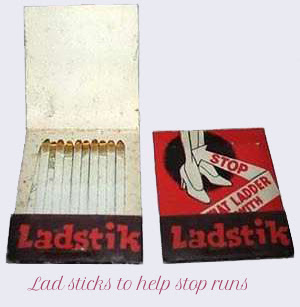
Instruction are printed on the back of the packet telling the lady to moisten the tip of the stick in her mouth and rub it onto the top and bottom of the run, it also says that the substance used is not harmful for her, it's the same principle which was used more recently with nail varnish.
One such product was called lad stick manufactured by Griffith & associates Ltd of Bristol, most likely made in the latter half of the 40's.Wartime black market nylons.

With the general shortage of nylon stocking it's inevitable that an illegal black market would soon sprung up it is very unclear how all the stocking found their way onto the black market, the cost of a pair of nylon stocking on the black market could be as much as $20 in the U.S.A.
There are several true stories about nylons stocking been made especially for the black market in the U.S.A, one is where thirteen cases of nylon yarn was stolen in transit to a parachute factory eventually ending up at a hosiery mill where the yarn was made up into stocking.
Another story was about a silk mill who had a contract to make glider tow rope and with a little false accounting managed to make a large quantity of yarn disappear, subsequently making this yarn up into nylon stocking.
Other cases included rayon stockings been sold as "nylons". The documentation for these along with other examples is held at the smithsonian.org there must have been many more black market nylons stocking schemes which when undetected throughout the war years.
Post war years and we have
nylons again. 
Production of nylon yarn for stocking started up again in the UK in December 1946 the production of yarn was controlled as it was destined for the export market to earn valuable money for the country, going to only to a few hosiery knitters who were on a what was called the " Preferred list" Aristoc been one of them along with I. R Morley's these companies were chosen because of its large number of contact they had abroad to market the nylon efficiently. Nylon stocking for home consumption was still restricted as the clothing rationing did not end until 1951.

British nylon spinners had the capacity supply most industries with their requirements for nylon yarn, at that time it had the largest factor floor in Europe with approx. 15 looms going all day, clothing might be the exception this as rationing remained in force until 1951.

In the USA the production of nylon yarn and also stockings which were destined to be sold to the ladies started again in 1946 it took a little while before the production was satisfying demand and in several cities including Pittsburgh fights broke out in the street when 40,000 ladies queued up for only 13,000 pairs of nylon, called "the nylon riots" in the popular press.

By the mid 1950's nylons were readily available again for any lady the buy whenever they wanted a pair, these stockings were very much sheerer than what was seen in previous decades with a much larger range of shades.
The hosiery manufacture by now had time to buy brand new knitting machines and install them into their mill like the one above these were American Reading machines.

Stocking are now seam free !
The seam less stocking has kept making there appearances in various decades certainly in 1920 and again I think in the 1930 from what a few of my fellow vintage enthusiast tell me.
The drawback of these stocking and why they never took off was that the circular knitting machine could not decrease or increase the number of stitches
which would be required to make a fully fashioned stocking really they were just tubes of fabric with no shape, resulting in these seam free or seamless stocking been ill fitting and slightly baggy compared to the fully fashions stockings.

It was not in the 1950's when a new generation knitting machines come onto the market made first by an Italian companies then followed by Japanese companies, these were circular knitting machine which for the first time were capable of automatically altering the number of stitches in a row, decreasing then increasing the stitches thus making it possible for ladies to have fully fashioned sheer stocking which were seamless.
Aristoc
introduced these machines into Langley mill which was of Italian
manufacture and produce there first seamless stocking in 1959
The seamless stocking were made with a flat nylon yarn and plain
knitted with almost no stretch they were sold by foot size between a 9
and 12 in and in length
from 29 inches to 31
inches even today over 50 years on they are still wearable.
The first hold up stocking.
It's always a bold statement to make by any one that you are the first to do something, however Pretty Polly claim on their web site that they invented the first hold up stocking in March 1967 and called this new style of stocking " Hold up" they never registered this trade make and over the years it has become a wildly used generic name. I have seen adverts for stocking which claim not requiring suspenders to hold them up so this needs some more research.
The very first pantyhose.
In 1953 Allen Gant senior started work on developing the
panty-tights and panty-legs
or as we know them today as pantyhose or tights, they introduced the
first
commercial pairs to ladies pantyhose in 1959 made by (Glen Raven Mills
of North
Carolina) Allen Gant mill.
Previously the company made parachuted in WWII they started off as a
cotton
mill in 1880 by John Quinton Gant, today this company make high
performance
fabrics and wove the flag which was used on the moon landings
These panty-tights were received a very mixed reception from both
ladies and
also from other rival hosiery manufactures.
Ladies were familiar with the concept of tights, because the thicker
tights had
been worn in theater by actresses and circus performers not
mentioning ballerinas
for many years. Ladies were very uncertain about the pantry hose for
several
reasons.
Some of the reason why the pantyhose or tights were not well received at first.
Initially been very expensive: costing up to four times the cost of normal stocking. The new seamless RHT nylon stocking had just come onto the market most ladies were switching to these instead of seamed FF stockings. The very first pantyhose or tights still had as this was a big disadvantage and a good reason not for changing over to them from the manufactures perspective I they were investing heavily in circular knitting machine and there would not get a return on this investment before having to reinvest. Marketing was very much geared up to RHT stocking, you can see this on many stocking packets well in to the 70's as they

Then the fashion designers had different ideas because it open up new possibilities for them and they stated to force the changed over too pantyhose or tights from stocking with the arrival of the mini skirt brought out by marry want in 1966 featuring hemlines ranging from four to seven inches above the knee worn by the younger generation which would bring the pantyhose to the forefront of the fashion scene because with these mini skirt you could see the ladies stocking tops.
Sheer pantyhose were a different matter it would take big
alteration in the
hemline of the skirt before pantyhose or tights would because
universally
accepted by ladies.
Aristoc advert from about 1967.
The change from stockings to pantyhose really started to take place in the mid to late 60's Aristoc in 1967, a large UK hosiery knitters made the required investment and started the production of tights (pantyhose).
As the decade progressed it was not just the young miniskirt wearers who started to wear the new pantyhose tights, more and more and ladies a were turning away from the opened bottom corselets and girdles and stocking to panty girdles which were easier to wear with trousers if you still wanted to wear a skirt then the same panty girdle could be worn with a skirt and tights.
Pretty Polly followed in 1968 with their own one piece tight competition and innovation changes the market.
From the late 1960's onwards foreign imports of hosiery especially from Europe, Germany, France and Italy now started flooding into Britain forcing the price down, along with the home grown competition manufactures were having to lowering the price of tights or pantyhose making them even more attractive for ladies to wear.
At the same time all this new competitions was forcing some manufacture out of business and other to merge with each other there were many takeover, brand acquisitions and mergers taking place with hosiery companies around this time, while others would fight back with innovation making changes to their brand and marketing.
This competition can also be seen on the hosiery packet search one telling the purchaser the merits of the particular pair of tights over another.

A better fit, sheerer fibres been used initially 15, then 10 denier thick fibres would come along in this decade and subsequent , different knitting patterns would be highlighted on the packet plain knit run resist, all these would came into play and used for marketing as a very important for the manufactures get ahead of the competition.
A Pretty Polly hosiery advert just as we change over to the decimal currency with 35 p ( pence) on the packet and the text say it is 7 shillings.
You would also see manufactures make it very clear on the packet that pantyhose and tights were seam free just like the stocking, some pantyhose would still have reinforced heel and toe (RHT ) other like Pretty Polly tell us about "Micro mesh".
Just a little about fishnet stockings & tights.

The origin of fishnet stocking and much later tights is a little unclear, certainly fishnet stocking were wore by Victorian ladies as a pair is documented on Ebay community about a pair of fishnet stocking were was once found in a pair of Victorian boots tucked out of sight in the toe area of the boots.
There is little factual information available about the true origins, fish net stocking or open work stocking would original have been crochet and not knitted which is a slightly different process.
Amanda Harper, Occasionally wears a pair of fishnets on BBC Look North.
Fishnets have come in out out of fashion on many occasions over the last hundred years, the 1920's and the 1950's are two of the decades when they were worn the most. Today fishnet tights are seen as been fashion hosiery available in many shades and net mesh from micro net to fence nets.
By the Severities tights have now captured the market.
By 1970 there had been a remarkable turnaround for tights or pantyhose as they had captured around 70% of the hosiery market and the popularity of tights and pantyhose continued to grow thought the seventies and into the eighties.
Hosiery knitters increasing the length of their stocking to the longer one which we are familiar with today so that ladies could wear them with the shorter shirts, tights were here to stay.
Very early tights still had seams up the back these were not "fashion tights" they were made similar to stocking knitted flat then sewn up the back.
Tights also had a big impact on the corset put simply there not need to wear a girdle or corsetle to just to hold up your stocking and these garment were been rejected in ever increasing numbers by younger ladies.
The Eighties and Hosiery.

Wolford
surprise every one
with two new pairs of
tights.
Wolford surprise every one with two new pairs of tights.
In 1987 The Austrian hosiery company Wolford well know for there innovators surprised every one with two very different pairs of tights which made the hosiery industry sit up and think about what they were all making as Wolford had moved on from been just another company making stockings and now tights to one which was creating new products.

first one was called "Opaque de Luxe" these tights used about twice as much Lycra as most other manufactures at that time, with other opaques which used with Lycra they had a strange sheen to them when wore in sunlight or bright artificial light, Wolford Opaque de Luxe was completely mat Black even under the strongest light.
The packet compared with ones today has little information on it apart from the size guide it just says -
Wolford Satin Touch. 
Was launched at the time as there Opaque De Luxe , because I had never worn a 1980's pair of Wolford Satin Touch apart from a different packaging and the shades available at that time I can only think that they are very similar to the ones sold today.
The Introduction of Lycra.
The next major innovation for hosiery was the introduction of an elastic fibre often called Spandex, developed in 1958 by Du point who registered trade name of this fibre and called it Lycra, the first uses of this fibre was in support or surgical stocking.

In
1982 Pretty Polly introduced Lycra into the 15 denier range and were
the first hosiery brand to successfully combine ultrafine bare Lycra
with a fine denier textured yam giving a much improved fit for fashion
hosiery.
By the mid 1980's 50% of all tights and stockings had some
Lycra
or spandex content , this gave a pair of stocking or tights the stretch
which h
is required for a better fit around the shape of the ladies leg without
looking
baggy these lycra tight did not requiring the boarding process which
was previously used
to make
the leg shape ,also these elastic fibre improve the durability and
appearance
of hosiery ,at first Lycra was a very expensive fibre and so you would
see
manufacture using only 2 or 3 % of the total fibber content of a pair
of tights
or stockings as the photo show Lycra is not used as a single fibre it
is woven
together with another fibre.
The stretch which Lycra has can be used to make the stocking
more supportive
as in support or control tights and compression hosiery or depending
upon how
it's knitted is used in very sheer tights to add stretch and thus
durability,
today we can find hosiery in the shops which are form 60 -70 % nylon
and 30
- 40% Lycra or a similar elastic fibre.
The Disappearance of Hosiery- Bare legs are once again in vogue.
Bare
legs have gone in and out of fashion many times in different cultures
around the world. Examples of this fashion can be found as far back as
1066 with the Norman peasant class commonly baring their legs.
Bare
legs in England were a source of contention during the 1929 Wimbledon
women's tennis tournament where a ban was considered and then
ultimately rejected by English authorities, bare legs in women's tennis
being the norm in both France and the United States at the time.
Whilst western women's fashions through the first half of
the
20th
century and beyond gradually made the revealing of the leg acceptable
or even the norm, the absence of any covering was often seen as having
particular sexual connotations.
The popularity of pantyhose grew
into a wardrobe staple throughout the 1970s and 1980s. From 1995 a
steady decline in sales of pantyhose began, levelling off in 2006 with
American sales less than half of what they had once been.
This
decline has been attributed to bare legs in fashion, changes in
workplace dress code, and the increased popularity of trousers.

Lady Diana Spence walked down the isle in July 1981 to marry Prince Charles wearing a dress made by David & Elizabeth Emanuel it is also said Lady Diana wore white silk stocking.
Princess Dianna choose of clothes was in the subsequent years like many members of the Royal family closely followed by the fashion conscious.
In the earlier years Princess Dianna wore hosiery to great effect as a integral part of her overall look, You could even say became a unofficial ambassador for the wearing of hosiery when the industry was going through difficult times.
A hosiery industry fights back.
The hosiery industry had gone through many changes over the years you could say this was the most serious as it was the first time that society and ladies in the western world decided that ladies did not have to wear hosiery any more to be correctly dresses.
They came back with one word " Legware" they seamed to be trying to put this over more as an Ethos of thinking about hosiery not been an essential item clothing, instead looking at hosiery more as been a fashion accessory to complement your outfit or style.
Ultimately in time this will lead to hosiery companies producing a multitude of fine knitted garment like patterned tights with elaborate designs on then changed each season to reflect the change fashion trend, legging , knee highs, sheer socks, capri tights ,over the knee socks.

Pretty Polly celebrates 50s years of hosiery making.
Pretty Polly celebrates 50s years of hosiery making.
In 1988 Pretty Polly celebrated 50th in business with the launch of Nylons with great success initially these were fake seamed stockings and tights in a celebration packet. The brand provided a glamorous sheen, a sheer look and Lycra for a great fit Pretty Polly then capitalized on this success with the launch of the none seamed Nylon tights and stockings.
Nylons were recreating the glamour of war time Nylons using the technology of the late 1980’s.
Over the years the packet have changed to keep the brand looking fresh.
In the last decade of the Twentieth century new fibres were starting to be introduced into hosiery like these Zokki tights.
 Zokki & Lycra 3D Tights.
“Zokki” refers to a Japanese knitting method where the entire tight—leg and waistband—is made from the same continuous yarn. This gives the tights a smoother, more uniform feel and better stretch Marks & Spencer sold Zokki tights in the late 1990s to early 2000s in Black, Nearly Black and Natural Tan.


To the best of my knowledge
Marks and Spencer's
were the only UK brand /
who use a Zokki yarn
This gives them a smooth, uniform appearance with no visible vertical lines.

They tend to feel softer, stretchers, and more form‑fitting than other types.
Marks and Spencer's
were the only UK brand /
who use a Zokki yarn

Here I am wearing a pair of vintage Zoki tights from M&S.
Now In The 21st Century Hosiery.
Is a multi billion pound world wide market, with more even Colours, a lot more Patterns and made from New fibres.

There was a time when a lady would go into a department store or local shop to buy a pair of stockings she would have a chose between two or three brands and only three or fours different shades to choose from.
Today it's totally different been a global market and many online retailers from the UK and abroad as easy to buy hosiery made in Italy , France or Germany as the ones produced in Derbyshire or a other UK brands. to choose from with hundreds of different brands There is now a unprecedented range of colours, patterns and thicknesses, apart from tights, holdups, stocking, over the knee, knee high , ankle high and foot sock are all on the market for us to choose from which I think is fabulous.
Then is also are a number of new fibres used to produce hosiery and improved knitting technics that hosiery producers can used these days thus stocking are not not just a pair of stockings anymore or tights for that matter.
Coloured Hosiery.
Fancy wearing a pop of colour today like Ruth Goodman .

As Ruth Goodman a popular social historian shows wearing coloured tights to complement her outfits filmed her in a social history program called Full Steam Ahead.
There was a time when stocking came in a limited range of shades each manufacturer having thereon pallet. The sixties is often thought about as the decade when coloured opaque tights were worn the most,

When you now look at the large range of shade available today from many of the top hosiery brands this might not be strictly true.
Keely
Donavon a weather and news presenter on BBC Look North is seen
here wearing coloured tights, a pair of deep purple opaque tights on the right & a pair of Moroon tights on the left, too great effect .


Tights Verses Stockings Today
there is no exact figure available today about the percentages of tights worn compared to stocking , , hosiery retailers and fashion analysts generally estimate that 80–90% of all hosiery worn are tights for Everyday wear, workwear, winter outfits, school uniforms, fashion with 10-20% is stockings/Holdups mainly worn in relation to special occasions, vintage fashion, niche styling.
Ultra Sheer and Nude Hosiery.
For many decades it had been a desired of ladies to be able to wear hosiery which add just a hint of colour to there legs still producing a flawless finish bringing out the natural beauty of there legs not looking like they wear wearing stocking or tights this would require a fibre making very fine which also could be knitted making this impossible until relatively recently the name given to these fine tights and stocking was Ultra sheer or Nude hosiery.
 Ultra sheers are defined as hosiery which is less than 10 denier in thickness, commonly ultra sheers are made of thicknesses ranging between 5 to 10 denier often made in a small range of colours , like these 5 denier Black Levante Resistenze tights which I wearing here.
Levante Ultra sheer Resistenze 5 denier tights in Black
Nude hosiery is just a variation on ultra sheer , referring to hosiery produced in more natural skin tones to match a the colour of your leg thus trying to give the impression that your not wearing any hosiery at all only adding a hint of colour and producing a flawless finish.
Many hosiery manufacture initially entered into this market of
How many women and male wear tights or Stockings Today.
Again there is no firm figure available for the percentage of women compared with men who wear tights or stocking , Retails sources seam to suggest that between 70 to 90% of women wear tights and stocking today, they also say that about 1-10% of men will wear tights and stockings, they go on to suggests that the male market is increasing.A Bunch of New Fibres.
Hosiery made with LYCRA 3D technology.
More stretchy and comfortable
Better fitting (they adapt to your legs more evenly)
More durable
More uniform in appearance — fewer streaks or patchy areas
More stretchy and comfortable
Better fitting (they adapt to your legs more evenly)
More durable
More uniform in appearance — fewer streaks or patchy areas.
The New Sideria Yarn.
Sideria yarn is one of the latest yarns to be developed and used in ultra sheer or nude tights and stocking , a nylon/polyurethane composite fibre created with conjugation technology, one of the specialties of KB SEIREN. It self-crimps when treated with heat, and thereby possesses moderate stretchability.
Heat treatment provides Sideria with even and uniform spiral crimps, ensuring neat and smooth knit surface effects. Moderate Stretch ability
Being a bi component yarn of nylon and polyurethane, Sideria guarantees an extra-thin and superbly transparent knit which is scarcely achieved by conventional covered yarns.
Crisp Feel
Sideria has excellent elastic recovery as well as low stress-induced stretch ability. Even low count filament yarns made of Sideria are soft and crisp to the touch, instead of having rough texture
How Sideria yarn is used.
Sideria is a super‑fine, ultra‑strong synthetic yarn used to create very sheer tights that still have unexpected durability. Brands use it to achieve a bare‑leg look at extremely low deniers (7–9 denier) while maintaining the strength of thicker hosiery.Retailers describe it this way:
Aristoc says their Ultrabare tights are “made from Sideria yarn which combines a truly bare 7 denier appearance with the strength of 15 denier”.
What makes Sideria‑based tights special?
Ultra‑sheer appearanceThey create a barely‑there look — perfect for summer or a natural finish.
Stronger than typical ultra‑sheers
Despite being 7–9 denier, they behave more like 15 denier tights in durability.
Smooth, even finish
The yarn helps avoid streakiness and gives a clean, natural leg tone.
Lightweight and breathable
Ideal for warm weather or when you want coverage without visible hosiery.
New fibres :- Microfiber.
This is the first of a new generation of fibres which are used in hosiery today.
Microfibers are fibers with a thickness of 1 denier, development of these fine fibres started as early as the 1950's. Microfibers were first publicized in the early 1990's in Sweden followed by Europe.
Microfiber is a synthetic fiber made up of a blend of polyester and polyamide or nylon. These materials are bundled together to form a strand that when examined under a microscope appears in the shape of a star. Those bundles are then split into ultra-fine single fibers using a specific combination of chemicals, heat and agitation. The fibers are finally woven together to make the finished microfiber product.
Microfiber by it's nature is a very soft fibre, today it tends to be used to produce opaque tights although when it was first launched into the hosiery industry several manufacture made sheer tights with Microfiber and the main selling point was the softness of the hosiery , I seam to remember from my own experience that these tights and stocking been very nice and soft to wear because of there sheerness they also had issues with the longevity.
No comments:
Post a Comment